Classic vs Contemporary Marble Design Styles begins with a practical question: should a room feel timeless, or unmistakably current? Marble can answer both, but the choice depends on veining, finish, scale, and daily use.
The global natural stone market was valued at approximately USD 33.06 billion in 2023, according to Grand View Research’s Natural Stone Market Report. Its forecast also indicates steady growth through 2030. This matters because marble is no longer limited to grand foyers. It now appears on kitchen islands, bathroom walls, fireplace surrounds, and compact furniture pieces. The Natural Stone Institute’s technical guidance stresses proper sealing, fabrication, and maintenance. A beautiful slab still needs responsible specification.
Interior designer Patricia Urquiola has said, “I like to work with materials that have a soul.” Her observation suits marble’s irregular character. Classic interiors often use Calacatta veining, polished surfaces, symmetry, and framed slabs. Contemporary schemes may favor honed finishes, book-matched panels, oversized forms, or quiet grey stone. Neither approach is automatically better.
The surface tells the story.
A polished white marble can reflect chandelier light across a formal dining room. A honed green slab may feel calmer beside oak cabinetry and brushed metal. Yet trends can age quickly. Even timeless marble can look misplaced when its scale ignores the room.
This guide compares Classic vs Contemporary Marble Design Styles through material performance, visual balance, cost considerations, and maintenance realities. Some recommendations remain subjective. That is worth admitting. A style board may look perfect, but fingerprints, etching, and changing daylight can challenge the original design. Reliable choices begin with evidence, experienced fabricators, and a willingness to question attractive assumptions.
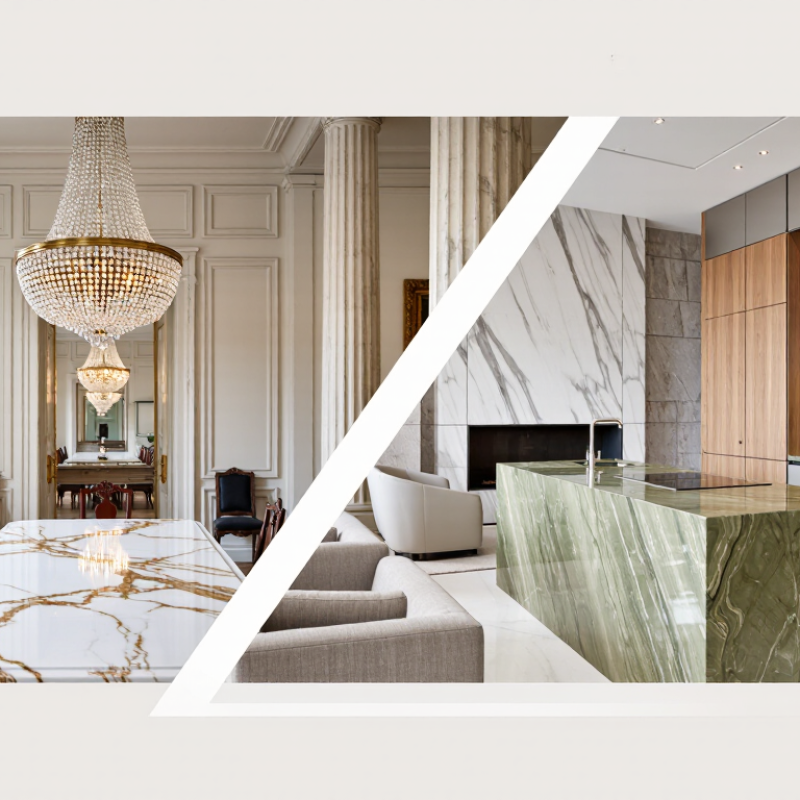
Classic marble style is defined by visual restraint, familiar proportions, and a sense of permanence. Its surface often shows soft veining, balanced movement, and warm white, cream, or gray tones. Honed finishes reduce glare and make older interiors feel calm. Polished slabs create sharper contrast beside dark wood or aged metal. In practice, classic marble works well around fireplaces, staircases, bathroom vanities, and formal entry floors. The material should look settled, not overly busy. A classic room can still feel fresh. It relies on details that age gracefully. I have found that matching vein direction at a doorway changes the whole impression. Small choices matter.
Contemporary marble style is defined by bold scale, cleaner lines, and deliberate visual tension. Strong veining, deep backgrounds, and book-matched panels can become the room’s main feature. Large-format slabs reduce grout lines and support a quieter, more architectural layout. Matte or leathered finishes add texture without excessive shine. Contemporary design suits kitchen islands, shower walls, and floating vanities with simple hardware. Yet modern does not always mean dramatic. A pale slab with nearly invisible veins may feel more current than a crowded pattern. Sample it under daylight and evening lighting. I once judged a gray surface in a showroom and disliked it at home. The undertone was warmer than expected. That mistake taught me to inspect full-size samples, not small chips.
| Comparison Dimension | Classic Marble Style | Contemporary Marble Style | Practical Selection Guidance |
|---|---|---|---|
| Overall Character | Timeless, formal, balanced, and inspired by historical interiors. | Minimal, graphic, relaxed, and focused on clean visual expression. | Choose classic for enduring elegance; choose contemporary for a fresher, more streamlined atmosphere. |
| Typical Color Palette | White, cream, beige, warm gray, and soft taupe. | Crisp white, cool gray, charcoal, black, green, or strongly contrasting tones. | Coordinate the stone with cabinet, wall, flooring, and natural-light colors before making a final decision. |
| Veining Pattern | Fine to moderate veining with a regular, restrained, or softly flowing appearance. | Bold linear veins, pronounced movement, book-matched patterns, or high-contrast graphics. | Use subtle veining for visual longevity and bold veining when the marble is intended to be a focal point. |
| Surface Finish | Polished surfaces are common because they emphasize depth, color, and formal character. | Honed, leathered, brushed, or lightly textured finishes are often used for a quieter, less reflective look. | Select polished marble for maximum reflection; select honed or textured marble to reduce glare and emphasize a matte finish. |
| Edge Profile | Rounded, ogee, bullnose, or other decorative profiles may reinforce a traditional appearance. | Straight, eased, mitered, or square-looking edges support a clean contemporary design. | Match the edge to the cabinetry and architectural detailing rather than choosing it independently. |
| Common Applications | Formal kitchens, fireplace surrounds, classical bathrooms, entry halls, and decorative floors. | Minimal kitchens, open-plan living spaces, modern bathrooms, feature walls, and streamlined vanities. | Consider the room’s scale, traffic level, moisture exposure, and maintenance expectations. |
| Design Compatibility | Works well with raised-panel cabinetry, wood trim, symmetrical layouts, and decorative metal details. | Works well with flat-panel cabinetry, handleless storage, simple hardware, glass, and concrete-like materials. | Repeat one or two visual cues throughout the room to make the marble feel intentional. |
| Visual Maintenance | Light, moderately patterned surfaces can soften the visibility of minor marks and everyday variation. | Large areas of solid or dark marble may show dust, water spots, etching, and fingerprints more clearly. | Marble is calcium carbonate and can react with acids; use pH-neutral cleaners and wipe spills promptly. |
| Durability Considerations | Traditional style does not determine hardness; performance depends on the specific stone and installation. | Contemporary style also does not guarantee greater durability; finish, thickness, and stone characteristics remain important. | Review the slab’s technical data, inspect for natural fissures, and confirm suitability for the intended use. |
| Best Choice When | You prefer warmth, symmetry, decorative detail, and a style designed to remain visually familiar over time. | You prefer simplicity, contrast, strong material expression, and an uncluttered architectural setting. | Let personal taste lead, then verify lighting, maintenance needs, slab availability, and installation requirements. |
Note: Natural marble varies from slab to slab. Always approve the actual slab, sample the intended finish, and confirm care requirements before fabrication.
How to Choose Classic or Contemporary Marble Styles?
Marble style begins with three decisions: veining, color, and surface movement. Classic marble usually favors pale backgrounds, soft gray veins, and balanced repetition. Contemporary marble can be darker, warmer, or more dramatically veined. In a busy kitchen, broad movement may overpower cabinet doors and lighting. I have seen subtle slabs look richer after installation because daylight reveals fine mineral lines.
Color changes more than appearance. It affects maintenance visibility and perceived room size. White and light-gray marble reflect more light, while charcoal and green tones create visual depth. The 2024 NKBA Kitchen Trends Report identifies natural and engineered stone as leading countertop choices, showing continued demand for stone surfaces. However, trend data cannot replace a physical sample. Small samples hide large veins.
Finish also changes the experience. Polished surfaces sharpen color and amplify reflections. Honed finishes soften glare and make marble feel quieter. Leathered finishes add tactile texture, but they may collect dust around shallow patterns. According to Grand View Research’s 2024 Natural Stone Market Report, the global natural stone market reached an estimated 2023 value above 30 billion dollars. That scale reflects durable demand, not proof that every style suits every room. My own preference can mislead me. View full slabs under warm and cool lighting, then check the surface after water, oil, and daily handling. A beautiful choice can still be impractical.
Comparison of typical visual characteristics: veining, color, finish, and surface patterns
Classic marble usually emphasizes pronounced natural veining, warm or high-contrast colors, polished finishes, and traditional flowing patterns. Contemporary marble tends to favor restrained veining, neutral colors, honed or matte finishes, and cleaner surface patterns.
Choosing classic or contemporary marble begins with the architecture, not fashion. A restored townhouse often benefits from veined stone, honed surfaces, and softly rounded edges. These details echo cornices, timber floors, and aged metalwork. In a modern apartment, large-format slabs and quiet backgrounds reinforce clean lines. Yet contrast can work. A traditional kitchen may feel sharper with a restrained, lightly polished island.
Study the room’s light before approving a sample. Daylight can make cool marble appear gray, while warm lamps emphasize cream and gold tones. Place a full-size sample beside cabinetry, flooring, and window trim. Small samples can mislead, especially when bold veining crosses a long vanity. Consider scale, too. Busy movement may suit a compact fireplace but overwhelm a narrow hallway. Water, cooking oils, and foot traffic also matter. Ask fabricators about sealing, edge details, maintenance, and expected variation. Natural stone is never perfectly uniform.
Tips:
Match polished marble with formal spaces.
Choose honed marble where glare or heavy traffic is a concern.
Keep one visual feature dominant.
If the stone has dramatic veining, simplify nearby colors and hardware.
Test grout and lighting together.
Do not decide from a screen.
I once preferred a cool gray sample, but it looked stark beside existing oak. That mistake reinforced a useful rule: the best marble supports the building’s character instead of competing with it.
Choosing marble means weighing appearance against daily performance.
Classic styles often use soft veining, carved edges, and warmer tones.
Contemporary designs favor clean lines, broad slabs, and stronger visual contrast.
Style matters, but performance decides whether the surface remains enjoyable.
Marble is durable, yet it is not damage-proof.
Acidic foods, cosmetics, and hard water can cause etching or dull marks. Darker stones may hide stains, while pale marble can reveal every splash.
Sealing helps, but it does not prevent every mark.
That limitation deserves honest attention.
Maintenance should match your routine.
Wipe spills quickly with a pH-neutral cleaner, use cutting boards, and avoid abrasive powders.
Contemporary slabs may reduce grout lines, making cleaning easier. However, repairs can be more visible across large uninterrupted surfaces.
Classic layouts may disguise small changes through natural variation, but extra joints and trim collect dust.
I once underestimated this detail during a renovation review. The design looked elegant, yet daily cleaning became inconvenient.
Long-term appeal also depends on how comfortably the marble ages.
A few small marks may add character, or they may become a constant frustration.
Consider replacement costs, household habits, and future buyers before choosing purely by appearance.
Choosing the right marble style begins with your space, not a trend. Classic marble often suits rooms with traditional furniture, warm wood, and detailed moldings. Its soft veining can make a bathroom feel established and welcoming. Contemporary marble usually works well with clean cabinets, simple lighting, and open layouts. Strong veining can create a bold focal point on an island or shower wall.
Consider the room’s natural light before choosing a slab. Pale marble reflects sunlight and can brighten a narrow hallway. Darker stone may add depth, but it can feel heavy in a poorly lit kitchen. View the actual slab in morning and evening light. Light changes everything. Measure twice. I once selected a beautiful sample that looked too busy beside patterned floor tiles. The stone was not wrong; the combination was.
Practical use matters as much as appearance. Honed surfaces hide small scratches better than polished ones, especially in busy kitchens. Ask how the marble was sealed, how often maintenance is needed, and whether the surface suits your cleaning habits. A professional fabricator should explain vein direction, edge details, and possible variation between samples. Do not expect a showroom image to match every piece. Natural stone is inconsistent, and that is part of its character. Still, accepting variation does not mean ignoring poor planning. Pair the marble with your daily routines, available light, and furniture proportions.
Classic marble often has pale backgrounds, soft gray veins, and balanced repetition. Contemporary marble may use darker colors or dramatic movement. Neither is automatically better.
White and light-gray marble reflect more light and can make rooms feel larger. Charcoal and green tones create stronger visual depth. Warm lighting may emphasize cream and gold shades.
Small samples can hide large veins. A bold vein may cross an entire vanity or island. Small samples deceive. View the complete slab beside cabinets and flooring.
Polished marble sharpens color and reflects more light. Honed marble reduces glare and feels quieter. Leathered marble adds texture but may collect dust in shallow patterns.
Traditional homes often suit veined stone, honed finishes, and rounded edges. Modern apartments may benefit from large-format slabs and quiet backgrounds. Contrast can still work.
Daylight can make cool marble appear gray. Warm lamps may strengthen cream and gold tones. Check samples under both lighting types before deciding.
Broad veining may overpower cabinet doors and lighting. Consider restrained movement when many surfaces already compete. Ask about sealing, cooking oils, cleaning, and expected variation.
Do not choose marble from a screen alone. A cool gray sample once looked stark beside oak flooring. My preference misled me. Test the stone in the actual room.
Choosing between classic and contemporary marble styles begins with understanding their defining characteristics. Classic marble design typically emphasizes timeless elegance, balanced veining, soft neutral colors, polished finishes, and traditional surface patterns. Contemporary marble design often features bold movement, contrasting tones, honed or textured finishes, and more expressive patterns. The comparison of Classic vs Contemporary Marble Design Styles should consider how veining, color, finish, and surface texture influence the atmosphere of a room.
The architectural setting is equally important. Classic marble can complement traditional interiors, heritage-inspired spaces, and formal rooms, while contemporary marble may suit modern homes, minimalist layouts, and statement areas. Homeowners should also evaluate durability, maintenance requirements, and long-term visual appeal, since different finishes and patterns may affect cleaning and everyday performance. By balancing personal taste, architectural character, practical needs, and future adaptability, you can select a marble style that enhances your space and remains attractive for years.

CKY Home